SwarmWatch is Live: Tracking the Explosion in Low Earth Orbit

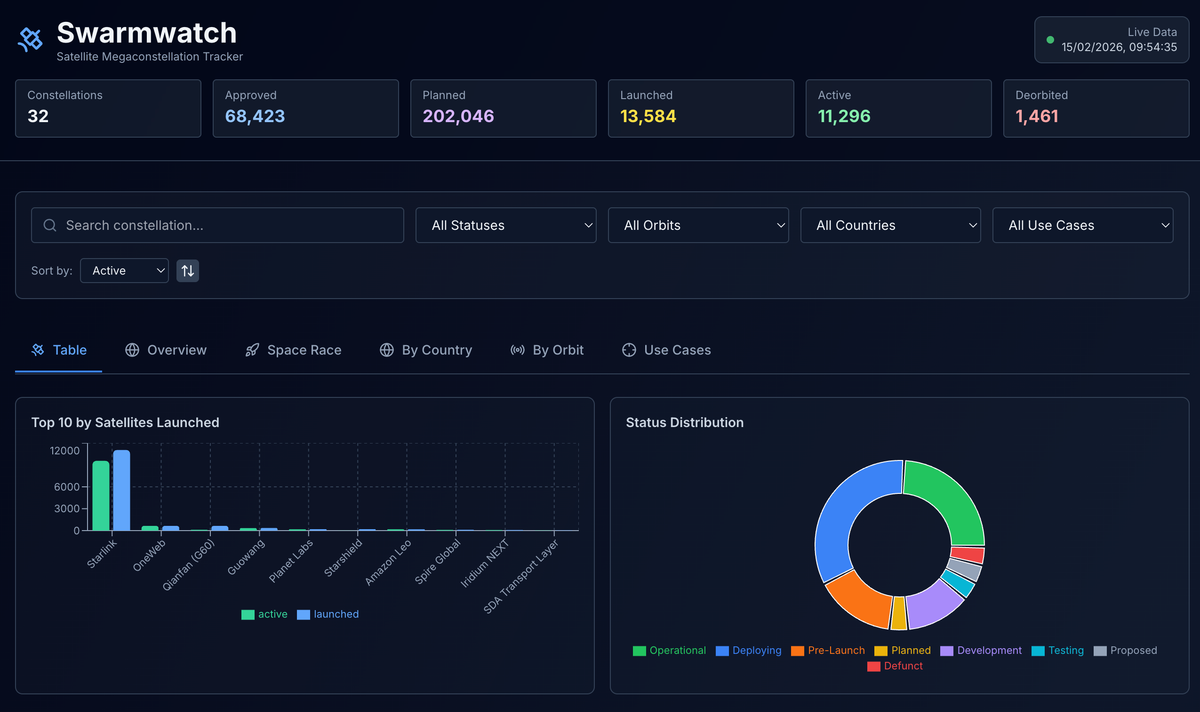
After months of research and development, I'm excited to announce that SwarmWatch is now live. This interactive tool tracks the explosive growth of mega-constellations and provides real-time visibility into one of the most significant transformations happening in space today.
Why SwarmWatch Matters
When I began researching mega-constellations for my forthcoming book Swarm: The Rise of Megaconstellations and the Battle for Low Earth Orbit (Potomac Books), I kept running into the same problem: people struggle to grasp just how dramatically the orbital environment is changing.
The numbers tell a stark story. In 2019, there were roughly 2,000 active satellites in orbit. Today, that figure exceeds 11,000, and we're on track to reach 100,000 within the decade if all goes to plan. SpaceX's Starlink alone has launched the bulk of those now in orbit, with approval for tens of thousands more. Amazon Leo, Blue Origin, OneWeb, and Chinese mega-constellations are racing to deploy their own networks.
But numbers on a page don't convey the scale of transformation. SwarmWatch was built to change that.
What SwarmWatch Does
SwarmWatch provides live tracking and historical analysis of satellite constellations, with a focus on the mega-constellations reshaping Low Earth Orbit. The platform offers:
Real-time constellation monitoring - Track active satellites by operator, constellation, and orbital parameters. See exactly how many satellites Starlink, OneWeb, or other operators have deployed and where they're positioned.
Growth visualisation - Interactive charts showing deployment timelines, launch cadences, and the acceleration of the new space era. Watch the exponential curve unfold in real-time.
Orbital congestion analysis - Understand how mega-constellations are filling specific orbital shells and what this means for space sustainability, collision risk, and future access.
Comparative metrics - See how different constellations stack up in terms of size, orbital characteristics, and deployment strategies.
The goal isn't just to present data - it's to make the scale and implications of mega-constellations visceral and comprehensible.
The Security and Policy Implications
As I've argued in my academic work and in upcoming publications, mega-constellations represent far more than a commercial success story. They fundamentally alter the strategic landscape of space.
These systems are dual-use by nature. Starlink has proven critical in Ukraine, providing resilient communications when terrestrial infrastructure was destroyed. But this same capability raises questions about space as a contested domain, the vulnerability of distributed satellite networks to cyber and kinetic threats, and the challenges of managing an increasingly congested orbital environment.
The regulatory frameworks designed for an era of dozens of satellites are struggling to cope with an era of tens of thousands. Orbital debris, frequency coordination, and the long-term sustainability of space activities are no longer theoretical concerns - they're urgent policy challenges.
SwarmWatch emerged from my belief that better data visualisation and public understanding are essential to informed policy debates. How can we have meaningful discussions about space traffic management, orbital rights, or constellation vulnerability when most people can't visualise the problem?
Beyond the Launch
SwarmWatch is a starting point, not a finished product. I'm planning regular updates to add new features, expand coverage to planned constellations, and incorporate additional data sources on debris, conjunction events, and orbital decay.
I'm also exploring partnerships with researchers, policy analysts, and space security professionals who might benefit from enhanced visualisation and analysis tools. If you're working in this space and have ideas for collaboration, please reach out.
Try It Yourself
Head over to swarmwatch.dev and explore the data. See for yourself how dramatically our orbital environment has changed, and how much more change is coming.
The mega-constellation era isn't a future scenario. It's happening now, satellite by satellite, launch by launch. SwarmWatch is here to help us all keep track.