The Last Patrol
The United Kingdom has maintained a continuous at-sea deterrent (CASD) since 1969, code-named Operation Relentless, meaning at least one nuclear-armed submarine is always on patrol, hidden in the world's oceans.


The Continuous At-Sea Deterrent (CASD) and Second-Strike Policy
The United Kingdom has maintained a continuous at-sea deterrent (CASD) since 1969, code-named Operation Relentless, meaning at least one nuclear-armed submarine is always on patrol, hidden in the world's oceans. This policy ensures a "secure second-strike" capability: even if the UK were devastated by a surprise nuclear attack, a submarine would survive at sea to retaliate. The UK's nuclear doctrine is fundamentally defensive. Successive governments have stated Britain would consider using nuclear weapons "only in extreme circumstances of self-defence", deliberately keeping potential adversaries guessing about the exact scenarios in which the UK might launch, but emphasising that the UK deterrent exists to retaliate, not to strike first without provocation. Unlike some other nuclear powers, the UK has not adopted a formal "no first use" pledge; however, its arsenal (currently submarine-launched Trident ballistic missiles only) is designed primarily to survive any first strike and respond. In the UK's view, this second-strike posture guarantees that any aggressor knows an attack on Britain will invite a devastating response, thereby deterring such aggression in the first place.
Vanguard to Dreadnought: The Submarines and Their Arsenal
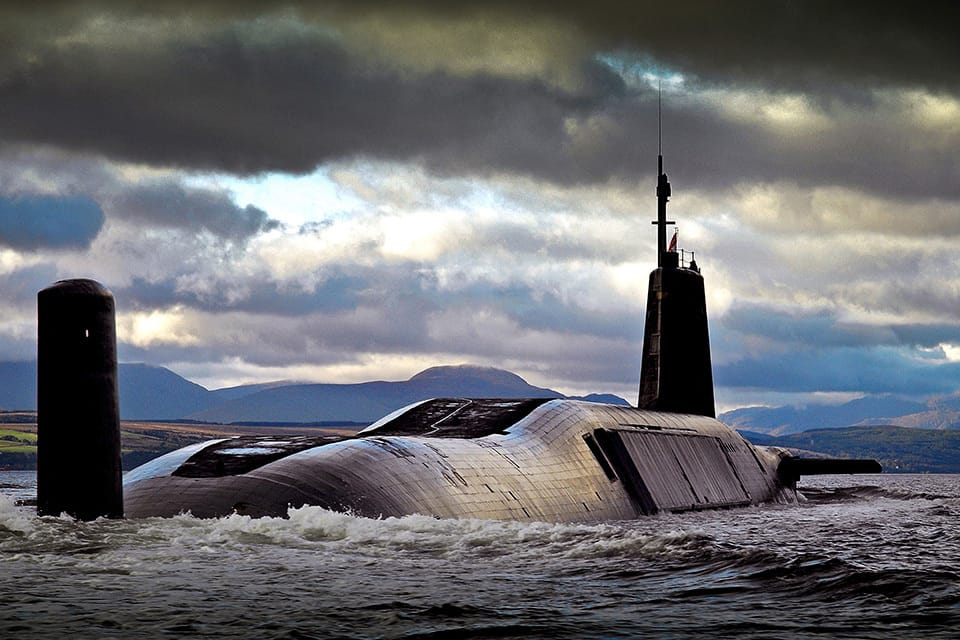
For the past few decades, Britain's deterrent has been carried by four Vanguard-class nuclear submarines (HMS Vanguard, Victorious, Vigilant, Vengeance). Each Vanguard-class boat is huge, around 150 meters long, 16,000 tonnes submerged, and carries up to 16 U.S.-made Trident II D5 ballistic missiles in vertical launch tubes. While each missile could carry up to 8 warheads (for a theoretical maximum of 128 per sub), the UK has long limited the load for policy and arms-control reasons. In recent years, a single submarine on patrol carries about eight missiles armed with a total of about 40 warheads. (Each warhead has an explosive yield of up to 100 kilotons, roughly 8–10 times the bomb that destroyed Hiroshima). The warheads are the British-made "Holbrook" thermonuclear devices, similar to the US W76, which can be independently targeted (MIRVs), meaning one missile can hit multiple targets. Even with a load of 40 warheads, one British Trident submarine could devastate dozens of cities or military sites in a second strike. Indeed, British planners historically insisted on a "Moscow criterion", the ability of one sub to obliterate Moscow and other major enemy cities, to ensure the deterrent's credibility.
In our scenario set a decade from now, the venerable Vanguards have been succeeded by the new Dreadnought-class submarines. The Royal Navy is currently building four Dreadnought submarines (HMS Dreadnought, Valiant, Warspite, King George VI) to enter service in the early 2030s. These successor boats will carry the same Trident II D5 missiles, initially with the existing Holbrook warhead and later with the planned Astraea A21 warhead (in 12 launch tubes instead of 16), a crew of about 130 sailors, powered by a new PWR3 reactor and featuring improved stealth technologies. But their mission is unchanged: to quietly carry the UK's nuclear arsenal on continuous deterrent patrol, hidden deep underwater and ready, if the unthinkable happens, to launch a retaliatory strike.
Life on a Deterrent Patrol
A deterrent patrol typically lasts several months submerged, during which the submarine remains in radio silence, receiving only incoming messages. The crew is split into two rotating teams ("port" and "starboard" crews) that alternate patrols. Life on board is isolated and routine by design. The submarine hides in the vastness of the ocean, running silent operations to avoid detection. The crew of 130 lives in relatively cramped quarters (though the Vanguard boats are more spacious than older subs, with four decks and improved living facilities). They have no internet or phone access and hear almost no news from home while deployed, except for occasional brief family messages, all to maintain absolute secrecy and security.
Daily life involves drills, maintenance of the nuclear reactor and missile systems, and keeping the boat ready for action at a moment's notice. At any time, the submarine's radio room may receive a brief encrypted communication from Commander Operations (COMOPS) at Northwood. Most of these are routine check-ins or training messages. The crew do not sit at a launch key. Since the end of the Cold War, the missiles are kept at several days’ notice to fire rather than on immediate alert. This posture can be raised quietly if required, allowing the submarine to move from routine readiness to a launch state in a matter of minutes rather than days for as long as the patrol continues. This relaxed alert posture is meant to reduce the risk of accidental war; however, if a crisis escalated, the Prime Minister, via COMOPS, could order the patrol sub to higher readiness or transmit target coordinates to it, thereby dramatically shortening the launch notice.
The crew trains for the nightmare scenario: global tensions have escalated to nuclear war, and their submarine may get the order to launch its missiles. They all understand that their mission, deterrence, is to prevent this scenario from ever happening. Yet they must be prepared to execute orders that will unleash unimaginable destruction. The psychological weight is heavy; as one former Defence Secretary reflected, the responsibility implicit in the deterrent "shakes" every Prime Minister when they first take office. It undoubtedly weighs on the submarine crews as well.
The Flash Message: Receiving the Order to Strike
In our scenario, the worst has happened: a nuclear conflict has begun. Perhaps a hostile power (say, Russia in a NATO conflict scenario) has launched nuclear weapons at the UK. The ballistic missile submarine on patrol, let's call her HMS Warspite (one of the future Dreadnought-class boats), is deep under the Atlantic when the order arrives.
04:12:07 UTC
North Atlantic
Depth: 240 metres
Speed: 4 knots
HMS Warspite is drifting in deep water, engines at quiet running. The crew is asleep in their bunks or on watch in the control room. The lighting is low. The only constant sound is the hum of the PWR3 reactor far aft, a vibration so familiar that most of the crew no longer notice it.
The submarine has been submerged for seventy-six days.
No one on board knows that thirty-one minutes earlier, five Russian ballistic missiles broke free of their silos.
04:12:19 UTC
In the radio room, a young communications rating looks up from a crossword he has been filling in. The VLF receiver has chirped. A burst transmission has arrived on the submarine’s trailing aerial. It lasts less than two seconds. It contains a sequence of encrypted groups that look no different from the dozens of test strings received every week.
Protocol dictates routine handling.
He reaches for the printed authentication sheet.
Halfway through comparing the prefix group, his expression changes.
He calls out quietly.
“Radio to Control. Priority traffic.”
04:12:48 UTC
The captain enters the radio room, still fastening the top button of his shirt. The XO is at his shoulder. The communications rating hands over the sheet, his hand shaking slightly.
The captain reads the first line.
He stops breathing for a moment.
The message header matches one of four formats known only to the Prime Minister, the Chief of Defence Staff, and the captains of the ballistic missile fleet. It is the format used only for a possible release of nuclear weapons.
He reads the first authentication block aloud. The XO checks it against the sealed authenticator envelope held in the ship’s safe.
The blocks match.
There is no routine exercise code embedded.
This is not a drill.
04:13:26 UTC
The captain orders “Close the boat.” Internal communications move to controlled circuits. Watertight integrity checks are ordered throughout the boat
The crew sense something is wrong, but only the command team know the nature of the message.
The XO fetches the second authenticator from a safe that requires two keys held by separate officers.
The Weapons Engineering Officer opens the missile control panel and confirms the system status.
Three officers now independently verify the message as genuine.
At this moment, HMS Warspite becomes the most dangerous object on the planet.
04:14:11 UTC
In the control room, the final checks are complete. The Weapons Officer confirms what the captain already knows.
“Missile navigation alignment ready. Fire control systems online. All tubes available.”
The captain opens the firing protocol binder. His voice is calm, clipped, rehearsed. Every action now follows an exact sequence. There is no time to dwell on silence from Northwood. There is only the message in front of him, authenticated beyond doubt.
He issues the next order.
“Prepare to enable launch systems.”
04:15:02 UTC
In the missile compartment, sailors move quickly through their tasks. Mechanical safeties come off. Hydraulic lines pressurise. Electronics shift from standby to armed.
The inertial navigation system finishes its update. The stellar navigation check completes.
The submarine slows to three knots. A fractional pitch adjustment settles the boat for firing.
Everyone in the control room feels the tension in the hull. They know the moment the first missile breaks the surface, Warspite’s position will be revealed to anyone watching the North Atlantic.
The captain accepts this without hesitation.
“Continue.”
04:16:17 UTC
The XO reads the final authorisation line from the decoded message.
“Authentication complete.”
The captain responds.
“Authentication accepted.”
He reaches for the launch key. It is cold against his fingers, familiar yet never used for its true purpose.
The Weapons Engineering Officer unlocks the firing panel with a coded sequence. The safety cover lifts. The trigger switch is exposed. He rests his hand beside it, waiting.
The captain inserts his key.
He looks to the WEO.
A single nod.
They act.
The captain turns the key.
The WEO presses the trigger.
Two movements. Perfectly timed. Final.
04:16:31 UTC
The submarine shutters. A deep, physical thump reverberates through the hull. The first Trident missile has been ejected from its tube by a gas generator, travelling through a column of seawater.
In the control room, several crew members instinctively grab handholds. One rating whispers, “Christ.”
Above the surface of the Atlantic, a white plume erupts as the missile breaches the waves. Six seconds later, the first stage motor ignites, illuminating the night sky. No one on the submarine sees it. They feel it as a faint change in vibration.
HMS Warspite has just launched a nuclear weapon.
There is no way to recall it.
04:17:49 UTC
Eighth tube fires.
In seventy-eight seconds, HMS Warspite has deployed the entire at-sea nuclear arsenal of the United Kingdom. Eight missiles, each carrying multiple thermonuclear warheads. Enough destructive power to kill millions and to erase entire cities.
The captain orders:
“Rig for silent running. Emergency depth. New course one-eight-zero.”
The submarine begins to dive.
04:18:11 UTC
Five hundred miles away, in the upper atmosphere, the bus section of the first missile separates. Small thrusters orient its trajectory. One by one, warheads and decoys are released, each dropping into its ballistic arc.
Each warhead contains fuel components manufactured in a facility in Berkshire. Each contains guidance programmed in Scotland. Their destructive yield is eight to ten times that of Hiroshima.
They fall silently.
04:23:56 UTC
The submarine is now deeper than 300 metres. Speed has increased to 22 knots. The hull creaks with pressure.
In the control room, the captain stares at the depth gauge. The crew avoid eye contact.
He knows that somewhere behind him, a Russian early warning satellite has detected the launches. He knows that retaliatory systems, automated or human, may already be firing back.
He also knows that the United Kingdom may already no longer exist.
No confirmation signal has been received.
04:28:44 UTC
Over the adversary’s territory, the first British warhead detonates.
There is no sound underwater in the Atlantic.
The crew do not feel it.
But at that precise moment, the strategic fate of two nations is sealed.
04:29:12 UTC
North Atlantic
Depth: 320 metres
Speed: 22 knots
The control room is quiet except for the sound of the reactor pumps. No one speaks. The chart table light throws a faint glow across the captain’s face. He watches the comms repeater display. It remains blank.
The XO leans in.
“Still nothing from Northwood.”
The captain nods once.
Protocol requires immediate confirmation of command continuity after a launch. The submarine waits for a follow-on message. It does not arrive.
04:31:44 UTC
The communications rating initiates the first scheduled encrypted poll. He transmits a short burst acknowledgement through the VLF trailing aerial.
There is no response.
He checks the antenna feed. He runs a diagnostic on the receiver. Both are functioning.
He sends a second burst.
Silence.
He looks at the XO.
“Comms systems check out. No return.”
The XO does not reply.
04:34:02 UTC
The captain reaches for internal communications.
“Control to Engineering. Status.”
“Engineering green. Reactor stable. Primary and secondary coolant are operating normally.”
“Control to Weapons.”
“All missile tubes are empty. Safeties reinstated. No further launch capability.”
The captain knows the submarine no longer holds strategic value as an attacker. It now has one purpose: to survive.
04:36:57 UTC
The sonar operator raises his head.
“Possible transient, bearing zero-nine-three. Weak. Could be biologics.”
The captain orders a change of depth. The submarine angles down. The hull groans lightly.
The crew hold their breath.
The transient fades.
04:41:13 UTC
The XO stands at the captain’s side.
“We should have received a post-launch directive.”
The captain does not look up.
“Agreed.”
There should have been a coded message confirming national authority. There should have been a redirect order. There should have been a survivability instruction that told the submarine where to go.
Nothing has come.
04:44:28 UTC
The communications team switch to the secondary VLF band. They run a full sweep. They check the ELF receiver.
Nothing.
This silence is unprecedented. Even during major NATO exercises, the deterrent fleet maintains intermittent contact.
The captain orders the next step.
“Radio. Longwave continuity check.”
The rating pauses. Everyone in the control room understands the significance.
04:45:03 UTC
Radio room
The captain adds a further order.
“Bring us to reception depth. Deploy longwire.”
In the control room, the diving officer adjusts depth. The submarine rises slowly, maintaining silent running. At 120 metres, a buoyant longwire antenna is released from a deck housing and trails upward through the water column.
In the radio room, the rating tunes the longwave receiver to 198 kHz.
It is the BBC Radio 4 frequency.
If Radio 4 is broadcasting, the United Kingdom is assumed to still function.
He adjusts the dial.
Static.
04:45:57 UTC
He checks the antenna feed. He switches to the secondary receiver circuit.
Static.
He fine-tunes the set.
Nothing. Not even a carrier tone.
He reports quietly.
“Control. No Radio 4.”
04:47:12 UTC
Control room
The XO closes his eyes briefly. He understands the implication.
The captain remains expressionless.
“Repeat the check.”
04:49:01 UTC
Second attempt at reception depth.
Static.
The communications team run a check on grounding and antenna resistance. All systems function.
The captain issues the following order.
“Initiate scheduled emergency broadcast listening watch. All known national frequencies.”
The communications team work rapidly, switching through encrypted naval circuits, government emergency channels, broadcast services, and contingency frequencies.
Every one of them is silent.
04:53:36 UTC
The XO speaks in a low voice.
“We have to consider the possibility.”
The captain responds.
“We follow procedure.”
He does not allow speculation.
04:58:02 UTC
The communications officer approaches.
“Captain. No traffic from Northwood, Faslane, or secondary broadcast nodes. No civilian broadcast. No encrypted signalling.”
He hesitates.
“This has never happened before.”
05:00:17 UTC
The captain gives the order that everyone has been dreading.
“Prepare for last resort assessment.”
The control room becomes still.
This is the formal process to determine whether the United Kingdom has ceased to exist as a functioning state.
It requires:
• repeated comms attempts
• verification across multiple channels
• waiting through scheduled broadcast windows
• cross-checking against known timing patterns
Only after this procedure can the captain consider opening the Prime Minister’s letter.
05:12:44 UTC
Third Radio 4 check at reception depth.
Static.
No trace of modulation.
The communications rating removes his headphones. His hands shake.
05:18:32 UTC
The XO approaches the captain with the sealed safe access card.
“Sir. We need to discuss the time threshold.”
The captain checks the clock.
It has been more than an hour since the last routine broadcast.
In every simulation, this would already be considered a catastrophic loss of command.
05:24:19 UTC
The captain speaks quietly.
“Bring the safe keys.”
Two officers leave the control room.
Everyone present knows what this means.
The captain is preparing to open the safe that contains the letter of last resort.
05:27:51 UTC
Captain’s cabin
A locked safe sits secured against the bulkhead behind the captain’s bunk. Inside it is a second, smaller safe that requires two physical keys held by different officers.
Neither has ever been opened at sea.
The officers stand silently before it.
05:29:04 UTC
Control room
The captain rests his hand on the chart table.
If he opens the letter, it means he has judged that the United Kingdom may no longer exist.
He thinks of his family in Plymouth. He has no idea if they are alive.
He gives the order.
“Open the outer safe.”
05:29:17 UTC
Captain’s cabin
Two officers stand before the safe. Each carries a key on a chain worn under their uniform.
The senior of the two inserts his key into the upper lock.
The second officer inserts his into the lower.
They look at each other.
“Turn.”
The locks rotate with a heavy metallic click.
The outer safe door opens.
Inside sits a smaller, grey security container with a keypad and a mechanical lock.
This is the final barrier.
05:30:02 UTC
Captain’s cabin
The XO watches the clock.
The captain speaks quietly,
“Confirm no scheduled traffic.”
The communications officer replies.
“Next broadcast window passed. No transmissions.”
There has never been a moment in the history of the Continuous At-Sea Deterrent where all national communication paths remained silent for this long.
05:31:48 UTC
Captain’s cabin
The smaller safe requires:
• two physical keys
• a code known only to the commanding officer
• a final authentication phrase
The captain enters the cabin and kneels before the inner safe.
He inserts his key.
“Key one in.”
The XO steps forward and inserts his own.
“Key two in.”
The captain places his hand on the keypad.
He enters a sequence he has memorised since taking command.
He has never used it until now.
The safe unlocks.
05:32:19 UTC
The captain pulls the inner safe door open.
Inside is a single envelope.
White.
Unmarked except for one line handwritten in blue ink:
“To the Commanding Officer, HMS Warspite.”
The seal bears the crest of the United Kingdom.
The envelope is thick. The paper inside is heavy.
This letter was written by the Prime Minister within hours of entering office. It contains instructions that will only ever be read if the country that issued them no longer exists.
The captain reaches for it.
His hand hovers for a moment.
He takes the envelope.
05:33:04 UTC
Control room
The XO returns and stands silently beside the chart table.
The crew avoid looking at the cabin door.
They know what is happening. They have trained for it. None of them ever believed they would see it.
05:34:27 UTC
Captain’s cabin
The captain sits on the edge of his bunk.
He breaks the wax seal.
There is a soft tearing sound.
For a Royal Navy ballistic missile submarine captain, this is the most serious act he will ever take.
He unfolds the paper.
05:35:02 UTC
The letter begins with a short handwritten note in the Prime Minister’s own hand.
He reads the first line.
His expression changes.
He reads the next.
He stops.
He closes his eyes.
05:35:41 UTC
Control room
The communications rating stiffens.
On the secondary VLF monitor, a faint carrier tone flickers into view.
“Control. Possible weak signal. VLF band three.”
The captain enters the control room holding the letter.
“Hold reception.”
The rating makes a slight adjustment to the antenna feed. The signal strengthens slightly, then stabilises.
For three seconds, there is a scrap of modulation. Broken. Fragmented.
The captain steps closer.
“Identify.”
05:36:12 UTC
The modulation resolves into a narrow-band digital pattern, barely strong enough to decode.
The communications officer slips on the headphones and listens intently. He watches the decoder scroll a short burst of text.
His expression falters.
He removes the headphones slowly.
“Control. Automated continuity broadcast detected. No voice traffic.”
The captain nods once.
“Content?”
The communications officer checks the fragment again.
“Single instruction. ‘Stand by.’ Repeating. No originator confirmed. No attached directive.”
05:36:44 UTC
He reads the message header again, knowing what is missing.
“There is no authenticating signature. No human source. No follow-up.”
The control room falls silent.
Everyone understands what that absence means.
A contingency system is transmitting because nothing else is.
There is no confirmation from Northwood.
No confirmation from the government.
No return channel.
No human command authority.
05:37:19 UTC
The captain nods once.
“Log it.”
He raises the letter slightly.
“It confirms national command has ceased.”
He does not read the contents aloud.
05:38:03 UTC
Procedure dictates that the XO must witness the letter.
The captain hands it to him.
The XO reads the opening lines.
His jaw tightens.
He hands it back.
He speaks quietly.
“Understood.”
05:38:44 UTC
Control Room
The captain folds the letter and heads back to the Control Room.
He places it in his breast pocket.
He addresses the control room.
“United Kingdom command authority lost. We act in accordance with the Prime Minister’s written directive.”
No one speaks.
Several members of the crew stare at the deck.
One rating wipes his eyes.
Another grips the edge of the console until his knuckles whiten.
05:39:22 UTC
The captain issues the following order.
“Break reception. Return to depth.”
The diving officer acknowledges.
“Returning to patrol depth.”
Ballast tanks adjust. The submarine sinks back into the dark.
The buoyant longwire reels in silently through the upper housing.
The VLF carrier fades.
05:40:11 UTC
The captain stands at the centre of the control room.
He looks at the chart.
There is no guidance from Northwood. No surviving national command.
Only the letter.
He reads the final line again in his mind.
He gives the order.
“Set course as directed.”
05:40:29 UTC
The captain unfolds the letter once more.
He reads the final line in silence.
He looks up.
His voice is steady as he addresses the room.
“Our orders are to proceed to the United States. Where we will place the vessel under American command.”
No one moves.
05:40:52 UTC
The words settle over the control room like a physical weight.
For the crew, the meaning is immediate and devastating.
The United Kingdom no longer exists as a functioning state.
Their role as an independent nuclear force has ended.
They are no longer the final sovereign instrument of British power.
They are now an orphaned strategic asset, ordered to seek another nation’s authority.
05:41:17 UTC
The XO speaks first.
“Course to the western Atlantic?”
The captain nods.
“Yes. Avoid known patrol lanes.”
The navigator begins plotting.
A line traces across the chart table, curving away from Europe.
05:41:56 UTC
The sonar operator reports.
“Ocean clear. No contacts within detection range.”
The submarine turns slowly to starboard.
The change in heading is gentle but unmistakable.
Warspite is leaving the theatre of war.
05:42:33 UTC
In the wardroom, a junior weapons technician sits alone.
He stares at the bulkhead.
His family live in Portsmouth.
He mouths a single question.
“Why?”
05:43:11 UTC
Control room
The XO approaches the captain.
“Sir. The directive. It implies U.S. command is intact.”
The captain replies quietly.
“It implies they hoped it would be.”
There is no evidence that the United States survives. The letter assumes rather than confirms.
05:44:02 UTC
Protocol requires one final action.
The captain turns to the communications officer.
“Transmit acknowledgement. One-time pad. Minimum burst.”
The rating hesitates.
“Sir. If the United States did not survive, we would be declaring our position to any listener.”
The captain answers without hesitation.
“It is the Prime Minister’s order.”
05:44:39 UTC
A short encrypted burst leaves the buoyant antenna.
It rises through the Atlantic and propagates across the ionosphere.
Somewhere, it may reach nothing.
Somewhere, it may reach an automated American receiver.
Somewhere, it may be intercepted by an adversary submarine.
The crew do not know.
05:45:22 UTC
The diving officer reports.
“Patrol depth regained.”
The submarine settles into the dark again, engines at quiet running.
Lights are dimmed.
The longwire antenna retracts fully.
Warspite vanishes back into the ocean.
05:46:03 UTC
The captain stands alone at the chart table.
For the first time in the patrol, he allows himself a moment of reflection.
He realises that if the United States has fallen, the order condemns the crew to permanent exile.
No homeland.
No government.
No return.
05:46:51 UTC
He closes the letter and places it in a small document pouch.
He locks it in the cabin safe.
The act is deliberate.
Symbolic.
The letter that once represented a nation's final authority is now only paper.
05:47:33 UTC
Control room
The XO turns to the captain.
“Sir. What do we tell the crew?”
The captain considers.
“Tell them the United Kingdom has fallen. Tell them we are heading for potential allied command. Tell them the mission continues.”
05:48:12 UTC
The internal broadcast circuit clicks on.
“Ship’s company. This is the captain.”
A pause. Not hesitation, but care.
“You have carried out your duties with absolute professionalism. I need you to hear this clearly. We have lost all contact with the United Kingdom. National command authority is no longer responding.”
Another pause. A breath.
“Our orders remain in force. We continue as directed in the Prime Minister’s letter. We hold together. We stay steady. Every one of you is vital to this ship.”
He lets the silence settle.
“Warspite endures. That is our task now.”
He releases the switch.
For several seconds, no one speaks in any part of the submarine.
05:49:01 UTC
In the missile compartment, sailors sit on the deck plates.
One begins to cry quietly.
Another puts a hand on his shoulder.
No words are exchanged.
05:49:44 UTC
HMS Warspite has changed.
Moments ago, it was the silent core of the United Kingdom’s nuclear deterrent, a weapon held in reserve by a functioning state.
Now its missile tubes are empty.
It has become a displaced warship, its nation gone, its authority drawn from a single sheet of paper.
A strategic asset without a homeland.
And it is heading west.
This account draws on publicly available material on the United Kingdom’s Continuous At-Sea Deterrent, Trident operations, and Royal Navy procedures. Open sources do not cover every aspect of CASD activity or nuclear command and control, and specific operational details remain classified. Where information is unavailable, events have been inferred from credible defence analysis, historical practice, and established technical principles. The result is a work of informed fiction that remains grounded in what is known while recognising the limits of what can be confirmed.