The Hardest Part of Leaving Earth

Consider a strange asymmetry at the heart of the modern world. Humanity now builds technologies that operate at the scale of the entire species. Nuclear arsenals could end organised civilisation in an afternoon. Artificial intelligence promises to reshape every economy simultaneously. Cyber capabilities move through a single global network that recognises no border. Orbital infrastructure wraps the planet in a mesh of satellites on which billions of people unknowingly depend. Each of these is civilisational in scope. Yet the political units that command them would be recognisable to a seventeenth-century diplomat: territorial states, jealous of their sovereignty and locked in competition for advantage.
This asymmetry is usually treated as a management problem. Arms control regimes, export controls, standards bodies and summit diplomacy exist to keep species-scale technology within the grip of state-scale politics. Sometimes this works tolerably well. Sometimes, as the first nuclear age demonstrated, it works only by the narrowest of margins. But there is a version of this problem that we have barely begun to think about, and it concerns the most expansive technological project humanity has ever attempted: the movement of our species beyond Earth.
The question is easily stated. What if the greatest obstacle to humanity becoming an interstellar civilisation is political rather than technological?
Put that way, it sounds almost like a provocation. The engineering challenges of deep space are, after all, staggering. Radiation, propulsion, life support, closed-loop ecology and the sheer tyranny of distance form a wall of problems that may take centuries to solve. Nobody should minimise them. But engineering problems have a particular character: they are tractable in principle, and they yield to sustained investment; progress against them compounds. Political problems behave differently. They can regress. Institutions that took generations to build can collapse in a decade. Trust, once broken, does not obey Moore's law. It is at least worth asking whether the binding constraint on our long-term future lies in the domain we understand least well.
The politics of an interstellar civilisation will not begin with the launch of the first starship. It will be shaped much earlier, through the institutions, identities and rivalries that govern humanity's expansion through its own solar system.
A journey with no clear destination
Space activity is accelerating on every axis. Launch costs have fallen by an order of magnitude in twenty years. More than a hundred nations now operate satellites. Commercial constellations outnumber government spacecraft many times over. Lunar programmes are underway in Washington, Beijing and a widening circle of partner capitals, and serious money is flowing towards permanent infrastructure rather than flags-and-footprints symbolism. Whatever one thinks of the timelines promised by entrepreneurs, the direction of travel is unmistakable. Humanity is becoming a spacefaring species in fact, whether or not it has decided to become one in intent.
Notice, though, what is absent from this picture. There is no political subject to whom this expansion belongs. The International Space Station was an achievement of plumbing and diplomacy alike, yet it was always a partnership of states, and its successor arrangements are fragmenting along familiar geopolitical lines. The Artemis Accords and the emerging Sino-Russian lunar partnership are beginning to sketch what could become rival institutional architectures for the Moon. When people speak of "humanity" going to Mars, the word does real rhetorical work precisely because no institution exists that could give it meaning. Humanity, as a political actor, does not exist. States exist. Companies exist. Agencies and alliances exist. The species, as such, has no address.
For most of history this has not mattered. It may begin to matter enormously.
Whose flag flies on Mars?
Imagine a permanent settlement on Mars in the 2060s. Not a research outpost on the Antarctic model, rotated and resupplied, but a community: children born there, industries rooted there, schools, grievances, a generation that has never felt Earth's gravity. What political identity does that community hold?
The lazy answer is that it holds whatever identity its founders brought. An American settlement is American and a Chinese settlement is Chinese; a corporate settlement belongs, in some yet-to-be-litigated sense, to its shareholders. The Outer Space Treaty of 1967 forbids national appropriation of celestial bodies, but it says little about the political status of people who live on them because it was never designed as a constitutional framework for permanent off-world societies. The treaty regime governing space was built for a world of two superpowers and a handful of satellites. It is being asked to bear the weight of a multipolar, commercialised, potentially settled solar system, and the strain is already visible.
The deeper answer is that we do not know, and that the founders may not get to decide. Settler societies have a way of developing interests of their own, and identities to match. Empires that planted distant colonies repeatedly discovered this, usually at considerable cost. A Martian community dependent on Earth for survival but separated from it by months of travel time and up to twenty minutes of light delay would experience its parent state as something remote, expensive, slow and increasingly foreign. Whether such a community remains a province, becomes a partner, seeks autonomy or declares itself something new is a political question of the first order, and nothing in our current institutional repertoire is designed to answer it.
Is the nation-state enough?
None of this necessarily indicts the nation-state. The modern state system has proved extraordinarily adaptable. It absorbed the industrial revolution, decolonisation, nuclear weapons and the internet, in each case bending without breaking. One reasonable view holds that it will absorb space settlement too: jurisdictions will extend and treaties will thicken, until Mars ends up looking less like a new political frontier than like a very distant exclusive economic zone.
But there are reasons to wonder. The state is, at root, a technology for governing territory, and it evolved under specific conditions of bounded geography and shared vulnerability, in which enforcement was possible. Space weakens each of these conditions. Territory in orbit is a matter of regimes and trajectories rather than borders. Vulnerability becomes radically asymmetric between planetary populations. Enforcement across interplanetary distances may be impractical in ways that make sovereignty more nominal than real. Political forms are shaped by their material environment, and the material environment of space differs from anything the state system has previously digested.
History offers a suggestive pattern here, though not a deterministic one. Major technological revolutions have repeatedly placed political institutions under pressure to evolve. The printing press helped dissolve the universal church's monopoly on legitimacy and midwifed the modern state. Industrialisation produced mass politics, the administrative state, organised labour and eventually the welfare settlement. Nuclear weapons created the United Nations Security Council, the non-proliferation regime, the hotline and the strange stabilising theology of deterrence. In each case, a new capability exposed the limitations of existing political arrangements, and new arrangements emerged, unevenly and often violently. If space settlement is a transformation of comparable magnitude, it would be historically anomalous for it to leave our political forms untouched.
What science fiction knows
It is telling that much of the most sustained thinking about interplanetary politics has taken place in fiction. Star Trek's Federation imagines a unified Earth as the precondition for going to the stars: humanity gets its house in order first, then expands. The cyberpunk tradition inverts this, projecting corporate power into space and asking what happens when governance is a service you purchase. The Expanse offers a third model, a solar system fractured between Earth and Mars with an exploited Belt beneath them both, in which expansion reproduces terrestrial rivalry at larger scale and higher stakes.
These are not predictions, and they should not be read as such. What they reveal is the space of assumptions we carry. Much of the most politically serious science fiction treats the architecture of expansion as a central question, often more consequential than any drive technology. The fiction has grasped something the policy world has largely ignored: that ships are instruments, and the question of who commands them, and under whose authority, is where the story lives. When multiple imagined futures agree that politics is the plot, it may be worth asking why our research agendas treat it as an afterthought.
Concepts in search of a literature
Several ideas seem to demand serious study, and currently receive less than they deserve.
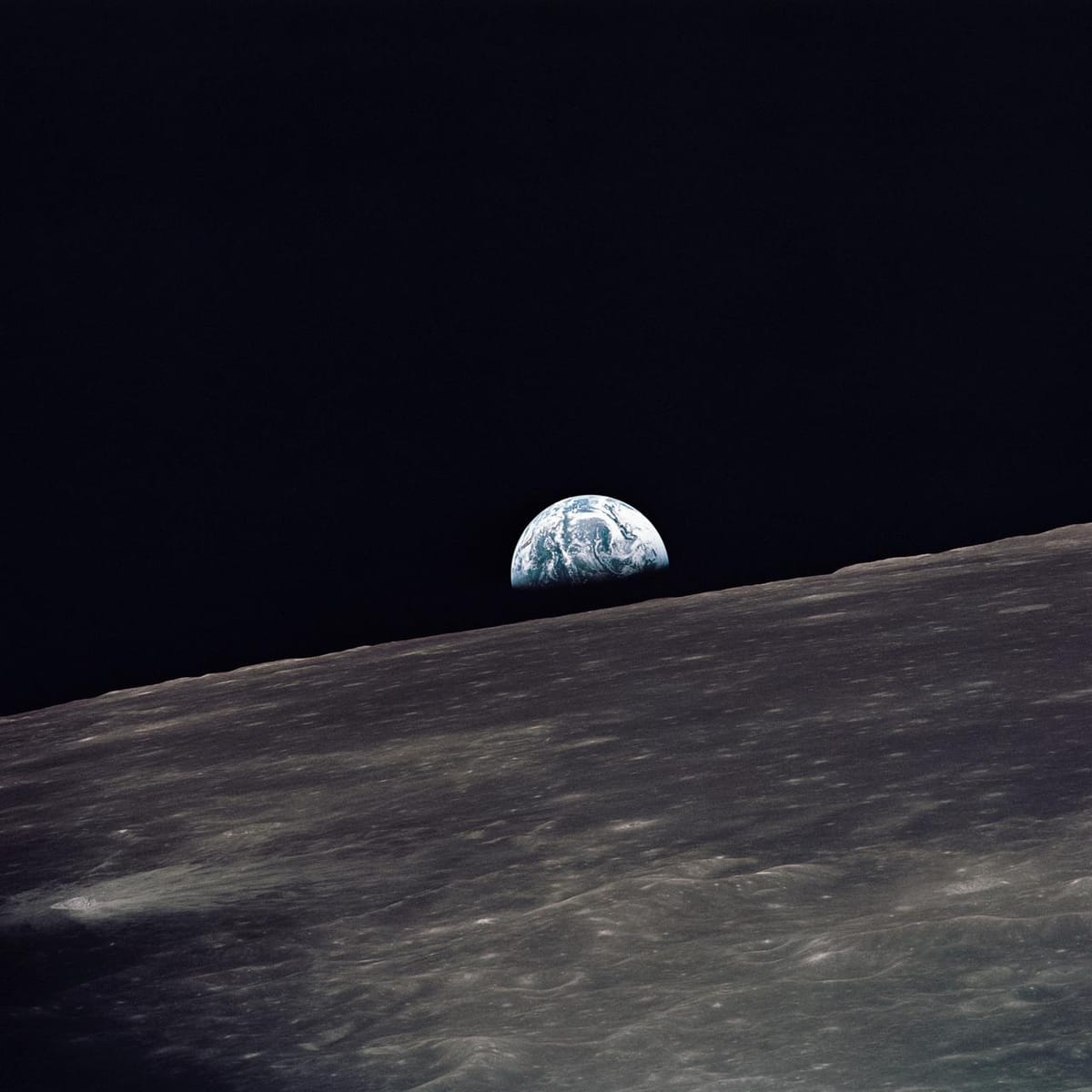
One is planetary identity. Astronauts have long reported the "overview effect", a shift in perspective produced by seeing Earth whole. Whether anything like a planetary political identity could emerge, what might catalyse it and whether it is even desirable are open questions. Identity has historically formed against an other; a species with no external rival may find planetary solidarity psychologically unavailable, or may discover it in shared existential risk.
A second is layered citizenship. The choice need not be between the nation-state and its abolition. The European Union, whatever its troubles, demonstrates that citizenship can nest: one can be simultaneously Bavarian, German, and European, with different rights attaching at each layer. A future settler might hold municipal, planetary, interplanetary and species-level affiliations in a similar stack. Whether such arrangements could scale across worlds, and what would hold the layers together, has yet to become a sustained field of inquiry.
A third is civilisational resilience. A species confined to one planet is exposed to single points of failure, which is among the standard arguments for expansion. Yet resilience is a property of political systems as much as of physical distribution. Two settled worlds locked in rivalry might be less resilient than one well-governed planet, because they add war to the catalogue of extinction risks. Expansion changes the risk portfolio; it does not automatically improve it.
A fourth is the distinction between global governance and world government. These are frequently conflated and profoundly different. Governance describes the thickening web of regimes, norms, standards and institutions through which states coordinate without surrendering sovereignty. Government implies a single authority with enforcement power. The case against world government is old and strong: concentration of power at that scale invites tyranny with no exit. Daniel Deudney has argued that space expansion itself could generate pressures towards dangerous hierarchies. The case for stronger governance is also compelling: coordination failures at civilisational scale are how species-level projects die. The problem may not be how to create a single political authority for humanity, but how to create enough common authority to coordinate at civilisational scale without producing a sovereign from which there is no escape. Where the sustainable equilibrium lies between these poles may be one of the central institutional questions of the next century.
Running beneath all of these is the relationship between security, cooperation and survival. Security competition drives capability; the Moon landings were a Cold War project before they were anything else. Cooperation enables scale; no single state built the ISS. Survival, on the longest timescales, may require both at once, in a mixture we do not yet know how to specify.
And then there is the darkest framing of all. The Fermi paradox asks why, in a galaxy old enough and vast enough to have produced many civilisations, we observe none. One family of answers proposes a Great Filter, some barrier that few or no civilisations pass. The filter is usually imagined as technological or environmental: an energy trap, a self-inflicted catastrophe, an arms race that ends badly, a biosphere that fails. But it is worth sitting with an alternative. Perhaps the filter is institutional. Perhaps intelligent species routinely develop the physics of expansion and routinely fail to develop the politics of it, turning their civilisation-scale capabilities inward before they can turn them outward. On this reading, the silence of the sky is a graveyard of governance failures. This is speculation, and should be labelled as such. It is also, if even remotely plausible, a reason to take the political question seriously now rather than later.
The counterarguments deserve their due
This entire line of thought invites at least three serious objections, and any honest treatment must give them room.
Realists will argue that fragmentation is a feature rather than a flaw. Competition between states has been the great engine of technological advance; Apollo was rivalry made manifest, and the current lunar acceleration owes more to Sino-American competition than to any cooperative impulse. On this view, a politically unified humanity might be a stagnant one, and the demand for common institutions mistakes the source of our dynamism for an obstacle to it.
Institutionalists will counter that thickening cooperation is simply what happens when interdependence deepens. The history of the state system is a history of accumulating regimes, from postal unions to space traffic coordination. No dramatic constitutional moment is required; the scaffolding of interplanetary governance will be assembled piecemeal, as it always has been, by lawyers and engineers solving practical problems.
And sceptics will reject the premise outright. Polynesian navigators settled an ocean larger than Mars is distant without any unified political identity. European expansion, for all its moral catastrophe, proceeded through rival crowns and chartered companies rather than through any continental consensus. Perhaps expansion has never required political unity, and never will. Perhaps a plural and competitive humanity will scatter across the solar system exactly as it scattered across Earth, and the demand for a common political subject is a category error.
Each of these positions is defensible. None of them is obviously correct. That is rather the point: we lack the research base to adjudicate between them, because the question has fallen into the gap between disciplines. International relations theory largely stops at the Kármán line. Space law is absorbed in near-term commercial questions. Existential risk studies treat governance as one variable among many. Astropolitics remains a small field oriented towards military competition in orbit. The long-range political preconditions of expansion belong to everyone, and sustained attention to them remains rare.
Questions worth asking
An essay of this kind should end with questions rather than conclusions, because the questions are what we currently lack.
What political forms, if any, does sustained expansion beyond Earth require? Can layered identities scale across planets, or does distance dissolve them? Would settlements strengthen civilisational resilience or multiply its failure modes? Is there a stable position between fragmented anarchy and dangerous concentration of power, and how would we recognise it? Do technological revolutions reliably drive political evolution, or have we been reading the causation backwards? And if political capacity is a filter through which expanding civilisations must pass, how would we know whether we are passing through it now?
We spend enormous effort asking whether humanity can build the ships that will take us to the stars. Perhaps the harder question is whether we can build the political civilisation capable of travelling in them.